jeudi 18 avril 2024

Unveiling the Architecture: Why ResNet18 Powered Our Image Emotion Detection Project


In our quest to build an accurate image emotion detection system, we explored various Convolutional Neural Network (CNN) architectures. After careful consideration, we opted for ResNet18, a powerful yet efficient model that stood out for its ability to tackle the challenges of image-based emotion recognition. This article delves into the inner workings of ResNet18, explores the reasons behind our choice, and sheds light on its advantages over other architectures.

Understanding Convolutional Neural Networks (CNNs) for Image Emotion Detection

CNNs are a class of deep learning models specifically designed for image recognition tasks. They excel at extracting features from images, making them ideal for applications like emotion detection from facial expressions. However, training deep CNNs often encounters the vanishing gradient problem, where gradients used to update model weights become infinitesimally small as they backpropagate through the network, hindering effective learning.

Introducing ResNet18: Overcoming the Vanishing Gradient Problem

ResNet (Residual Network) architectures were introduced to address the vanishing gradient problem. ResNet18, a specific variant of ResNet, incorporates a clever concept called skip connections. These connections bypass a few layers in the network and add the input directly to the output of the bypassed layers. This creates a shortcut path for the gradient to flow, ensuring it retains sufficient magnitude for effective learning even in deeper networks.

ResNet18 Architecture Breakdown 
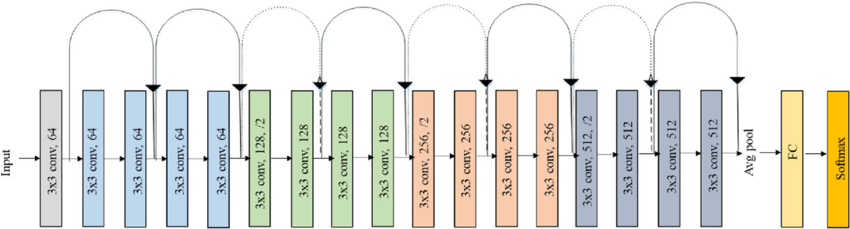

The core building block of ResNet18 is the residual block. It consists of two or three convolutional layers followed by a batch normalization layer and a ReLU (Rectified Linear Unit) activation function. The input to the block is directly added to the output of the convolutional layers through a skip connection. This architecture allows the network to learn residual functions, effectively adding information to the original input rather than attempting to learn the entire function from scratch.

Why We Chose ResNet18 for Image Emotion Detection

Several factors influenced our decision to utilize ResNet18 for our image emotion detection project:

  • Addresses Vanishing Gradient Problem: As discussed earlier, ResNet18’s skip connections effectively mitigate the vanishing gradient problem, enabling successful training of deeper networks. This is crucial for capturing the intricate details of facial expressions that convey emotions.
  • Balance Between Accuracy and Efficiency: Compared to deeper ResNet variants like ResNet50 or ResNet101, ResNet18 offers a commendable balance between accuracy and computational efficiency. This is particularly advantageous for real-world deployments where resource constraints might exist.
  • Transfer Learning Potential: Pre-trained ResNet18 models are readily available, allowing us to leverage their learned features for our emotion detection task. This approach significantly reduces training time and improves the model’s ability to generalize to unseen data.

ResNet18 vs. Other Architectures

While ResNet18 proved to be a compelling choice for our project, it’s essential to acknowledge other prominent CNN architectures:

  • VGG Networks: VGG architectures, like VGG16, achieve high accuracy but often require more computational resources due to their deeper structures (You can find more details on VGG16 in this paper: Very Deep Convolutional Networks for Large-Scale Image Recognition by Karen Simonyan and Andrew Zisserman, ICLR 2015: https://ui.adsabs.harvard.edu/abs/2014arXiv1409.1556S/abstract)
  • Inception Networks: Inception networks, such as InceptionV3, introduce efficient ways to handle filter sizes, but their architecture can be more complex to implement compared to ResNet (You can learn more about InceptionV3 in this paper: Rethinking the Inception Architecture for Compact and Efficient Deep Learning by Christian Szegedy, Vincent Vanhoucke, Sergey Ioffe, Jonathon Shlens, and Trevor Dean, CVPR 2016: https://ieeexplore.ieee.org/document/7780677)

Conclusion

ResNet18’s ability to overcome the vanishing gradient problem, coupled with its efficient architecture and transfer learning capabilities, made it the ideal choice for our image emotion detection project. By understanding its inner workings and the advantages it offers over other architectures, we were able to leverage its strengths to achieve promising results in recognizing emotions from images.


mercredi 3 avril 2024


Bridging the Gap: A Chatbot for Children with Autism using GEMMA and Longchain Technologies

For children with Autism Spectrum Disorder (ASD), social interaction and communication can present significant challenges.  Traditional chatbots, while helpful for some, often struggle to understand the unique communication styles and needs of children on the Autism Spectrum.  At THE CHAMPS, we're developing a next-generation chatbot specifically designed to interact with children with ASD, leveraging the power of GEMMA (Generative Multimodal Entity Model with Attention) and longchain architectures.  This article will delve into the "why" behind our approach, exploring the technical aspects of GEMMA and longchain models and how they can foster meaningful interactions for children with ASD.


The Challenges of Traditional Chatbots for Children with ASD

Current chatbots often rely heavily on natural language processing (NLP) techniques. While NLP excels at understanding formal language patterns, it can struggle with the intricacies of human conversation, especially the nuances present in children with ASD.  These nuances can include:

  1. Non-literal Language: Children with ASD may use figurative language or express themselves more directly, which can be misinterpreted by traditional chatbots.
  2. Limited Eye Contact: Some children with ASD may not make direct eye contact, a signal that most chatbots rely on to gauge user engagement.
  3. Focus on Specific Topics: Children with ASD may have strong fixations on specific interests, leading them to persistently discuss those topics. Traditional chatbots may struggle to maintain a conversation within these focused areas.

Why GEMMA and Longchain Architectures?

To address these challenges, we've chosen GEMMA and longchain architectures as the foundation of our chatbot for children with ASD. Here's a closer look at why these technologies are a perfect fit:


  • GEMMA: Understanding Beyond Words: GEMMA is a cutting-edge AI model that goes beyond just text. It can process and understand multimodal information, including facial expressions, tone of voice, and body language. This is crucial for interpreting the nonverbal cues that children with ASD often rely on for communication.
  • Longchain Architectures: Building Context and Following Interests: Longchain architectures excel at capturing long-term dependencies in conversation. This allows our chatbot to understand the context of a conversation, even if a child with ASD jumps between topics or repeats themselves. The chatbot can then maintain a natural flow of conversation within the child's area of interest.

Technical Deep Dive:  How GEMMA and Longchains Work Together

Imagine a child with ASD excitedly discussing dinosaurs with the chatbot.  The child might mention a specific dinosaur breed, then switch to talking about its size. GEMMA, analyzing the conversation, would not only understand the words spoken but also recognize the child's excitement through facial expressions and tone.  The longchain architecture would then connect these seemingly disjointed pieces of information, allowing the chatbot to respond by, for example, providing interesting facts about that specific dinosaur breed and its size.


=>This combined functionality allows the chatbot to not only understand the child's words but also grasp the underlying intent and emotions, fostering a more meaningful and engaging interaction.


Building a Brighter Future:  The Potential of Chatbots for Children with ASD

Our chatbot with GEMMA and longchain technology holds immense promise for children with ASD.  Here are some potential benefits:

  1. Improved Social Interaction Skills: By providing a safe and interactive environment, the chatbot can help children practice communication skills and build confidence in social interaction.
  2. Reduced Anxiety: The ability to understand nonverbal cues can help the chatbot create a calming and predictable experience, reducing anxiety often associated with social situations.
  3. Learning and Exploration: The chatbot can be programmed to be a source of information and exploration, catering to the child's specific interests and learning pace.

The Road Ahead:  Collaboration and Development

This project is at the forefront of AI-powered communication for children with ASD.  We believe in the power of collaboration and are actively seeking partnerships with researchers, educators, and parents from the Autism community.  Your input is invaluable in shaping the development of this chatbot and ensuring it meets the specific needs of children with ASD.

Together, we can build a future where technology bridges the gap in communication, empowering children with ASD to connect, learn, and thrive.

Beyond Recognition: Using AI to Create Inclusive Playgrounds for Children with Autism

Imagine a world where playgrounds aren't just about physical activity, but also about emotional connection. A world where toys understand a child's unique way of playing, and respond in ways that enhance their mood and social interaction. This isn't a distant dream; it's the potential future powered by computer vision technology.


At THE CHAMPS, we're developing a system that uses computer vision to analyze a child's face in real-time. This system goes beyond simply identifying age and gender. It delves into the realm of emotions, recognizing happiness, frustration, overwhelm, and more, specifically tailored for children on the Autism Spectrum. By analyzing facial features and subtle expressions, the system can understand a child's emotional state and adapt the play environment accordingly.

Building Bridges Through Play

Children with Autism often experience challenges with social interaction and communication. Playgrounds, while designed for fun, can sometimes become overwhelming due to sensory overload or difficulty understanding social cues. Our system aims to bridge this gap by:

  1. Creating Calming Environments: Imagine a swing set that dims the lights and plays calming music when a child shows signs of overstimulation. The system could also trigger interactive games projected onto the ground, offering a welcome distraction.
  2. Encouraging Social Interaction: Interactive toys could light up or make playful sounds when a child approaches another child, subtly encouraging social engagement. Games could be designed with cooperative elements, rewarding teamwork and communication.
  3. Promoting Independent Play: For children who prefer solitary play, the system could personalize the experience. A sandbox could project different textures and colors based on a child's gaze, creating a captivating and engaging solo activity.

Ethical Considerations: Transparency and Trust

Developing technology for children, especially those with Autism, requires a deep commitment to ethics. Here's how we're ensuring responsible development:
  1. Privacy by Design: Our system focuses on analyzing facial features, not identifying individuals. Parental consent will always be mandatory, and data will be anonymized.
  2. Focus on Empowerment: The goal is not to control a child's emotions, but to provide a supportive and adaptable environment. Children will always have the option to opt-out of interactions with the system.
  3. Open Communication: We believe in transparency with parents and educators. We'll provide clear information about how the system works and how data is used.

The Future of Play: Inclusive and Engaging

This technology holds immense potential to transform playgrounds into inclusive havens of joy and learning for all children. Imagine a future where every child feels comfortable, understood, and empowered to play in their own unique way.

At THECHAMPS, we're committed to developing this technology responsibly.  We believe AI can be a powerful tool for creating a more inclusive and engaging play experience for children with Autism.  By fostering a sense of connection and understanding, we can unlock the true potential of play for every child, allowing them to shine brightly on the playground of life.


Let's work together to build a future where every child can experience the joy and wonder of play.  Contact us at THE CHAMPS on FACEBOOK or the__champs on INSTAGRAM to learn more about how you can get involved.


Unveiling the Architecture: Why ResNet18 Powered Our Image Emotion Detection Project

  In our quest to build an accurate image emotion detection system, we explored various Convolutional Neural Network (CNN) architectures. Af...